Sunday, January 22, 2017

Creating Healthy Habits NOT Restrictions


I recently met up with a fellow dietitian and we started talking about the infamous “weight loss” topic.  We see many patients for weight loss and I was curious to see if he thought more people needed to learn how to eat healthy or if people were there for a general counseling session.  It’s hard for me as a dietitian to counsel on weight loss.  That may sound odd, but it’s the truth.  I may be able to educate you on how to eat healthy, but the bottom line is that there are often times many other issues facing the patients that contribute to their struggle with weight loss – stress at work, financial issues, relationship struggles – the list goes on.  And until one is able to find a way to deal with these life stressors, struggles with weight will continue to persist. 


So how do I counsel my patients?  I take each patient into consideration and have them self-reflect to see where some changes can be made in their life.  I believe that these small changes will add up to big results.  I might throw a lot of ideas at them of where other changes might need to happen, but the choice is up to them – start with one change at a time.  Don’t go trying to do: a three-day juice cleanse, a go to the gym every day for an hour, or NO CARBS EVER – because real life will sneak up on you and before you know it you’ve inched back into your old ways.   These quick fixes don’t work in the long-term.  I believe that people have good intentions and it’s not always about one’s will power.  Truthfully I believe the reason that “diets” bomb is because of this “all or none” mentality.  And it is a vicious cycle where it may work for a little while and in the beginning one is all gung ho, but then give it a bit of time and one’s good intentions start to falter and you feel demoralized and end up doing what you’ve always done.  The truth is that sustainable weight loss lies somewhere in the middle ground – choosing one small healthy habit, implementing it and then moving on to the next – you start small without feeling like you’re changing EVERYTHING all at once.  And the key is to find the small change that you need to make as no one small change will work for everybody.  These small changes can add up to big changes!  Here are a few suggestions for some small changes:

Track your food intake.  Don’t change a thing of what you’re currently eating, but simply begin to measure the amounts.  Portion control – you heard me.  That’s what we’re after.  Most people have NO idea what a real portion looks like.  We’ve been too desensitized to portions thanks to restaurants – I mean everyone wants to get their monies worth, am I right?? 


 After a day or two look back over your food intake to reflect and see what it is that you’ve been taking in.  Periodically check back into yourself and start to log the food intake again - The simple act of writing this information down has proven to be one of the most powerful weight loss tools.  The act of writing it down is about holding yourself accountable.  You might also want to note how you were feeling right before you ate it.  Were you angry, sad, or bored?  We often focus so much on foods and calories, but our emotions are a huge part of our eating habits.  (With many of the current applications, Fat Secret, My Fitness Pal, or Lose It, they will help calculate out your estimated caloric needs based on your height, weight, age, and estimated desired weight loss.  This will give you an idea of what your estimated nutrient needs are, to be able to see how on point or how not on point you are).  I am NOT a calorie counter – if that were the case, avocado would come out looking unhealthy compared to ice cream – and well, we all know that’s not the case.  But I do believe that we need to make sure we are consuming enough CHOs/PRO/FAT and in the right combos. 


Track Your Sleep.  You may have heard that there’s a link between sleep and weight – and there is!  Losing just 30 minutes of sleep each night can lead to long-term weight gain in adults (not to mention a range of other ailments:  diabetes, metabolic syndrome, heart disease, stroke, and cancer).  Adults typically need between 7-9 hours of nightly sleep (according to the CDC).  If you know you’re lacking sleep, aim to get at least a little extra each night.  Incorporate a soothing nighttime routine – meditate, have a warm bath (make sure to turn off your tablet – the blue light from the screen can disrupt your circadian rhythm).  The key is to settle your wakeful brain to sleep mode – and aim for consistency. 


Eat More Vegetables.  You’ve seen the USDA’s “My Plate” where half the plate is vegetables?  Well, eat MORE vegetables.  I often call it the “fiber factor” with my patients.  The fiber does a critical job in your body.  Most people associate it with “aiding in digestion”, which it does, but more than that, it slows everything down and can give you a sense of fullness.  This is critical when it comes to helping one eat fewer calories at a meal (as vegetables are often lower calorie).  Let’s be clear when I say EAT more vegetables (I did say eat, NOT drink) – the non-starchy vegetables:  Lettuce, spinach, kale, broccoli, cauliflower, mushrooms, asparagus, peppers, eggplant, zucchini, yellow squash, garlic, onions, and more.  (Starchy vegetables like corn, potatoes, peas, and the winter squashes are technically classified as carbohydrates.  They work quite differently than the non-starchy vegetables in the body).  I’ve been challenging some of my younger patients, the kiddos (and even adults) to try one new veggie a week and try it in all different forms to maybe find the form they might like.  For instance, with cauliflower, try it raw, steamed or roasted.  You can even turn the cauliflower into cauliflower “rice” or make a cauliflower crust.  As a side note, they say cauliflower is “in” this year – kind of like how kale had its time in the spotlight – although, I’m not really sure when it was ever “out”?  Anyhoo, the key is to think outside the box when it comes to veggies and begin to incorporate more in for the fiber factor.

Excited to try new vegetables, even if this black radish was a fail.
Move More.  The latest trend has been and still is fitness tracking devices.  They count your steps all day (and some even measure your heartrate!)   I’ll admit, I’m a little bit obsessed with my Fitbit.  Obsessed in a good way.  When I first got my Fitbit, I started to notice that by the end of the workday I’d be averaging 3,000 steps in a day (just while at work).  If I did my morning run I’d tack on between 5,000-7,000 steps on those days, but on the days when no exercise was happening, I was at less than 50% of what the recommended goal is of 10,000 steps/day.  What I started doing over this last year, was beginning to incorporate a morning walk, a walk at lunch, or an evening walk.  The key for me was simply moving more.  I was conscious of the fact that my job was sedentary but seeing the steps was the motivation for me to use those 10 minutes I’d arrive at work early to go for a quick walk.  The lunch time walk is important for me to simply get out of the building and get some fresh air (many times people think that they’ll get more work done if they eat their lunch at their desk.  Sadly, that’s not the case.)  I’d love to tell you I’ve gone every day this New Year, but that’s not the case.  I could beat myself and get upset about it or I can strive each day to get up and get moving and go for that lunch time walk!  Remember, small steps.  If hearing 150 minutes/week sounds like too much and un-obtainable, simply aim to get 10 minute intervals in when you can.  The movement makes a difference. 


Hydrate, Hydrate, Hydrate.  And I’m talking hydrate with WATER.  We’ve had an unseasonably hot and humid winter thus far in Miami (hello global warming).  And with that humidity needs the replacement of the water loss daily through sweating, etc.  More so, water is calorie free and the only drink that can truly quench your thirst.  I had a patient the other day that was having 2 sodas daily (the 20 ounce bottle size).  She admitted to being addicted to soda, but that was an additional 500 calories daily that by simply removing would allow for her to lose a pound/week.  She knew that they were extra calories, but wasn’t quite sure of how to eliminate them completely.  She wasn’t willing to eliminate them completely (too extreme), so I explained that maybe the way in which she could begin to make the change was to simply change the size of her soda.  Instead of a 20-ounce, 240 calorie drink, could she be satisfied with their 8-ounce, 90 calorie drink.  Remember, small changes.  Sure I’d love for her to completely eliminate the soda, but I also needed to be realistic.  She was willing to work on the amount that she was taking in when she realized I didn’t tell her to eliminate it completely.  Believe me, the end goal is to remove sodas completely, but it’s all in how you approach it.  We cut back 300 calories alone just with her drinks.  I then proceeded to show her other ways in choosing healthier options at the restaurants she was eating at to cut back even more.  Working where she was at and beginning to make small changes. 


When making dietary changes, start small and set realistic goals.  The path to a healthier lifestyle begins one little habit at a time.  Make the commitment to making healthy changes and by this time next year, you’ll be in a much better place.  Balance, moderation, variety, and one step at a time.  It’s not a diet; it’s a way of life.

Monday, January 2, 2017

Change YES!


Whole 30, Paleo, Military Diet – Lose 10 pounds in 3 days, Complete Guide to the Keto Diet – those are just a few of the popular weight loss diets this time of year (and throughout the year) via Pinterest.  I get it – it’s a new year and you want change – and that change is to lose weight and keep it off.  It is the number one New Year’s resolution, to lose weight.  It is for good reason that people want to lose weight:  more than 150 million Americans are overweight or obese, and across the globe an estimated 1.5 billion are affected.  Struggling with obesity is the problem of our time.


Search all over social media and there are people trying to give you the answers you are looking for.  They have the quick fix, the detox diet, the latest crazy trend of the time.  I even saw this morning a couple of food bloggers (one is a dietitian) offering up a meal plan of sorts – 21 days of healthy meals, recipes, and even a shopping list.  Now that ought to do it!  Yeah, no.  I can’t tell you how many people come in to my office and want a meal plan – Yes, I can make you a meal plan, but what does that solve?  NADA.  Absolutely nada.  Are you going to go to the store and buy all the ingredients?  Who’s going to make the food for you when you get home late at night and don’t feel like cooking?  The meal plan is NOT the answer.  Not to mention it’s the one thing I detest (just ask my co-worker.  Hate it).  I can teach YOU how to make your own meal plan.  Now that’s more of what I like to do.  Listen, I see countless number of patients in my office for weight loss and I’ll be the first to tell you that nutrition majors need to take more psychology classes.  I almost NEVER, I repeat, I almost NEVER am teaching a patient how to eat what is right and healthy during my sessions.  What I am doing is being a cheerleader and a coach and trying to get to the bottom of why people are doing what they’re doing.  I do not have the answers, nor do I claim to have the answers.  But I will tell you this – food is not the underlying issue – it goes much deeper.  And I’m sorry to be the bearer of bad news, but no crazy fad “detox” diet, is going to solve your problems. 


So yes, the New Year is a great time to re-group and figure out what needs to be changed in your life.  Throw out the concept of a resolution and start working on real everyday changes you can make in your life.   My yoga teacher, Marianne Wells, just posted on this same concept today – great minds do think alike, eh?  Change happens one moment at a time, not all at once.  Think of practical ways you can implement strategies towards achieving what it is that you want.  If weight loss is what that is, start breaking it down, one change at a time.  Attack the source of the problem and the symptom will go away. 
I’m going to throw out a lot of possible areas that you could change (from patients I’ve counseled).  But what I recommend is for you to sit back and really reflect on where it is that YOU need to change moving forward.  Small changes, big difference:


-Skipping breakfast

-Drinking sugary drinks (smoothies and juices included – yes I said it.  Worst.trend.ever!!)

-Drinking more water


-Check your alcohol intake – that can lead to increased eating (typically)

-Cutting back on the frequency of meals eaten out

-Getting your kids in the kitchen to help with the meal prep

-Meal prepping on the weekend to cut back on the time needed to cook dinner during the week

-Portion control (overeating carbs and not eating any non-starchy vegetables)

-Try a new fruit and/or vegetable each week.

-Mindless eating (typically late at night).


-Finding an exercise you like to do – it doesn’t have to be a chore – maybe you try a new exercise each week as well!

-Move more – we sit way TOO much (make it specific, maybe aim to walk 10 minutes at lunch)
-Have set meal times (so you can know when you’re mindlessly eating)

-Meditate


-Self-care:  taking 10 minutes every day just for yourself (reading, taking a calming bath, etc).


-Monitor your sleep patterns (how much sleep are you getting each night?  When do you turn off your tablet/computer, etc?)

I could keep going, but as I said, start reflecting to see where you need to implement changes.  And more importantly, be more accepting of yourself.  Sometimes we are our own worst critics – we judge and at times can be too harsh on ourselves.  Take each day as it comes being present in all that you are doing, choose to be grateful, and remember to strive for progress, not perfection! 


Sunday, December 18, 2016

That's A Keeper 6


I looked back at my last “That’s A Keeper” post and it was posted in January!   How did SO much time pass between me posting on some of my favorite recipes??  I’ll tell you how…life is busy!  Between training for my marathon, being crazy busy at work, and now the holidays, I’ve been trying to keep up with my blog every other week, but the truth is that hasn’t happened.  I haven’t been as consistent as I would have liked to, but as I always keep repeating, I’ll post when I have time and when I have something to talk about.  Which leads me to a few of my favorite recipes, that is definitely something to talk about.  There are always going to be hits and misses with recipes that I try, and I definitely wish I could read a recipe and know just by reading how’d it turn out.  I just don’t have that gift.  Nor do I have the gift of being able to concoct my own recipes.  So kudos to the people that do recipe development.  But I do have one favor to ask, can you really only post successful recipes?  I made some “Lemon Pistachio Shortbread Cookies” this morning – they do NOT stick together.  
Sure they look good...but you didn't see how many times they crumbled and fell apart!
When the recipe tells me to use my hands to roll them I just have to laugh.  I barely salvaged them by using a cookie scoop to try and get them to somewhat stay together.  The recipe should’ve read, “Be prepared to have them fall apart, all over you.  They will never really stick together, fyi.”  The flavor is okay, but truth be told:  these will NEVER be made in this household again and what a waste of all my pistachios.  Again, I wish I could read a recipe and just know if it’ll make keeper status.  Until that time, I keep trying so you don’t have to!


It is December 18th and it still feels like summer here in Miami.  I’m not complaining, I’m just stating the facts.  So having hot oatmeal in the mornings isn’t always my go to choice.  But I do love to have a breakfast that I can prep the night before and doesn’t take too much time in the morning.  This Vanilla Chai Oatmeal is full of flavor and just another way to put a spin on your normal oats.  The recipe calls for coconut milk – I’ve made it with both regular milk and coconut milk – and both turn out.  I used the regular milk for the extra protein.   Additionally I have cut out almost all added sugar in my diet (except for sweets like desserts!).  In this recipe it calls for between 3-4 tablespoons of maple syrup – I ended up eating this recipe 3 times, so in theory that’d be 1 tablespoon of maple syrup/serving – and that’s TOO much added sugar to start your day with.  Aim to start lowering the amount of sugar you’re using.  Your taste buds will adjust and get used to using less sugar.  Promise.  Other add-ons to this recipe – I always add nuts to my oatmeal to increase the protein content as well as increase my satiety from the healthy fats in nuts.  Get creative and switch up your flavors with your oatmeal.  This Vanilla Chai is delish! (no picture...all my overnight oats never look pretty!)

Whoever said eating their vegetables had to be boring was WRONG!  Dead wrong.  I think that sometimes people haven’t had a good experience with vegetables and therefore just write-off certain ones.  Or even worse, sometimes they haven’t even given the vegetable a try.  Salad is a good way to get your greens in – think spinach, kale, green leafy, red leafy, arugula, etc.  Not to mention add a few pieces of fruit and that always helps the vegetables taste better.  This salad combination uses pears and parmesan.  I also added in walnuts.  I’m always switching around the nut, the fruit, and the cheese.  The combinations are almost endless!  I have a persimmon waiting in the kitchen for my next salad.   And my go to salad dressing is this balsamic vinaigrette by Williams Sonoma. (I didn’t use the dressing in the recipe for the salad…too much sugar!)


Sauce:  Chimichurri

What more can I say but that this sauce is EVERYTHING!  And I do mean everything!!  For lunch I tend to eat grain bowls – whether it’s quinoa, couscous, farro, barley – whatever the grain is that’s the base of my bowl.  Then I’ll roast veggies for the week.  I do an assortment and rotate the veggies throughout the week to help get a variety.  For my protein I’ll rotate a soft-boiled egg, tofu, beans, and/or some nut concoction I’ve done – think cashew cream, almond “feta”, etc.  And lastly I add the sauce – this is where all the flavors come together.  I’ve been trying to build a repertoire of sauces to have on hand.  This way I can utilize a different sauce throughout the week and even though the essence of the bowl is the same, the sauce will let me think it’s a whole different bowl.  Chimichurri can be used in so many ways – even though I’m a pescatarian, it marries well with many flavors, not just meat.  Make this and you can thank me later!


Leave it to Real Simple to create a quick weeknight meal.  Little did I know when I stumbled upon this recipe I’d learn how to make full-proof soft-boiled eggs.  Score a W in the win column.  I’ve said this before, but I’m not the best in the kitchen.  If I could have a Go Pro camera watching my every move it’d be one for the history books.  Epic fails – coconut macaroon crusts falling on the floor and crumbling before my eyes, burning my hand on many a pan, creaming butter and sugar and sugar flying everywhere, yeah there have been some fails in this here kitchen of mine.  I follow the recipes, I swear I do!  Needless to say I was pleased when Real Simple directed me to the perfect soft-boiled egg.  Oh yeah, and the rest of the recipe is a score for a keeper also.  Simple, yet so flavorful.  The only thing I’d improve upon is by adding even more tomatoes.  Delish!


Seafood – Honey-Glazed Salmon

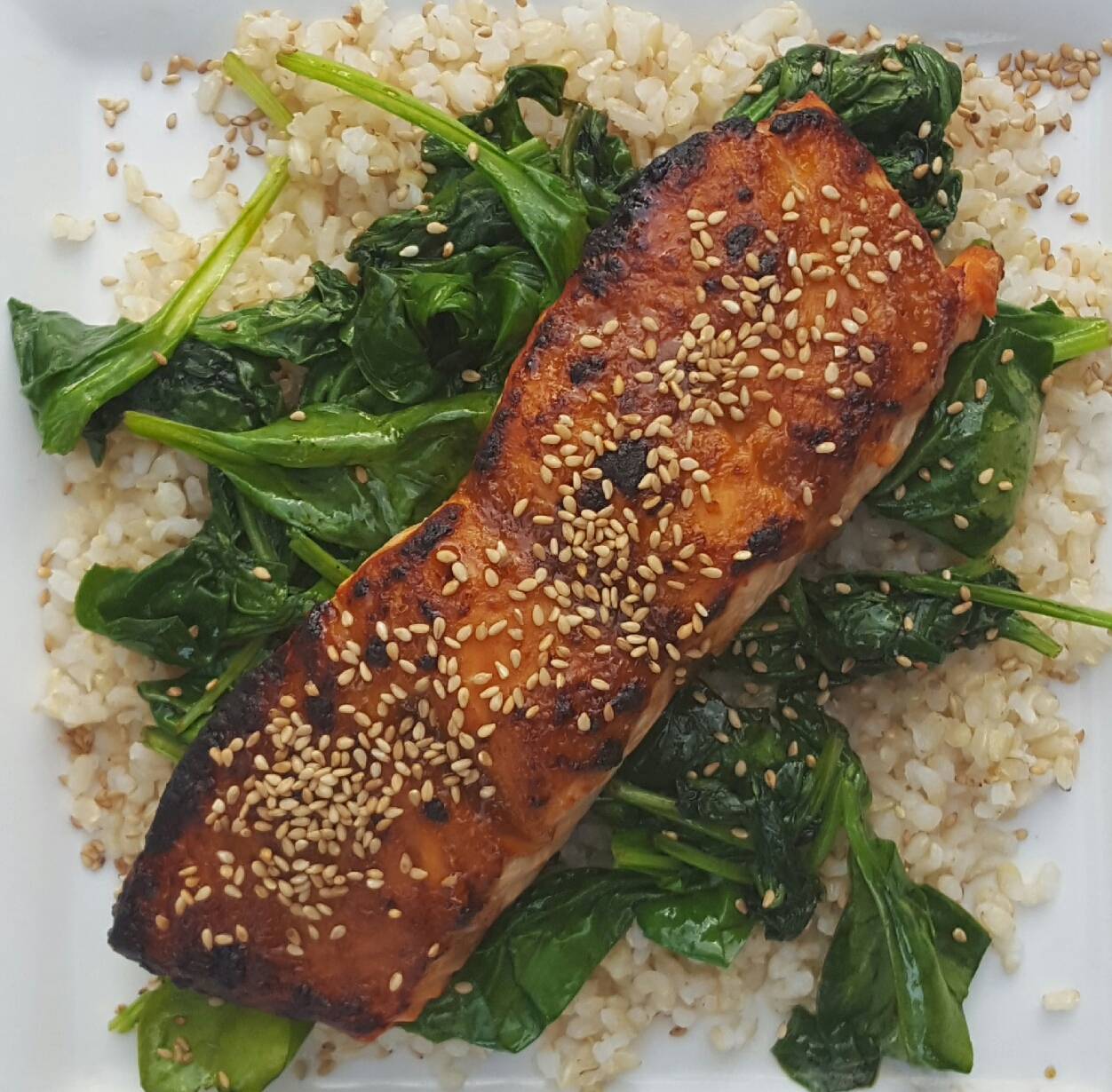
My tried and true go to salmon recipe.  While I’d love to experiment with others, this has been the one I keep using over and over.  I know I’m going to need a new one soon, but here are the many reasons why I love it – I can make the sauce up and use it throughout the week.  Two – I can leave the skin on the salmon when I get it from the seafood department at the store.  Three – Broiling the salmon makes for a QUICK weeknight meal (6 minutes on each side).  Four – training for the marathon has been challenging to ensure I’m getting enough protein (I spot check it occasionally and without the inclusion of the salmon I was eating WAY too much cheese).  I don’t love chicken, beef, turkey, pork, etc, but this salmon I can eat and enjoy.  I’ve been eating this three to four times/week to help ensure my protein on my run days.  Five – did I already say it’s a quick weeknight meal?  Well, that is if I remember to defrost the salmon the night ahead.  And don’t you worry, if that happens, it’s a breakfast for dinner kind of night!


I’ll start off by saying the picture doesn’t do these guys ANY justice.   I’m not exaggerating.  Not only am I a walking mess in the kitchen, I am also not the best photographer.  My skills have improved over the past few months, but this here photo was taken in my early days when I was just starting out.  The cheesecake in this recipe is a liquid cheesecake – it’s exactly what it sounds like – cheesecake, baked just enough for the batter to cook, but not enough for it to maintain its structure.  Essentially a no fuss cheesecake recipe.  Follow the step-by-step directions for the crust – at first you may doubt the process.  Don’t.  Hummingbird High gives THEE best directions.  I included a real dessert recipe here, not some of the paleo, low carb ones I’ve been trying as of recent.  It’s a week till Christmas.  It’s a holiday and holidays are meant to be enjoyed.  That includes desserts.  Just don’t get confused and think that every day is a holiday.  You know what I’m saying??


So there you have it – a few more recipes that have recently made it into my “keepers”.  I hope you see a recipe or two that you might like to try.  My stack of “recipes to try” keeps growing.  I wish they ALL were keepers!

Sunday, November 27, 2016

Diabetes Awareness Month


Diabetes Awareness Month -

November is American Diabetes Month®.  The American Diabetes Association notes that 1 in 11 people have Type 2 Diabetes – 1.4 million people in the United States are diagnosed with diabetes annually.  In 2012, 29.1 million Americans had diabetes.  While more attention is focused on Type 2 Diabetes, the numbers are staggering, today’s focus will be on Type 1 – of the 29.1 million Americans, 1.25 million American children and adults had Type 1.  So what is Type 1 (insulin-dependent or juvenile) Diabetes?  Type 1 Diabetes can occur at any age, but most commonly is diagnosed from infancy to the late 30s.  In this type of diabetes, a person’s pancreas produces little or no insulin. 

The causes are not entirely known, but scientists believe the body’s own defense system (the immune system) attacks and destroys the insulin-producing cells in the pancreas.  People with type 1 diabetes must inject several times every day or continuously infuse with insulin through a pump. 

Symptoms – may occur suddenly, however, the process may have been going on for some years:

·         Extreme thirst

·         Frequent urination

·         Drowsiness, lethargy

·         Sugar in urine

·         Sudden vision changes

·         Increased appetite

·         Fruity, sweet, or wine-like odor on breath

·         Heavy, labored breathing

·         Stupor, unconsciousness

If you think that you or someone that you know has these symptoms, call a doctor immediately.  Drink fluids WITHOUT SUGAR, if able to swallow, to prevent dehydration.  (If there is not enough insulin to get glucose into the cells to use for energy, the body turns to an alternative source of energy, and burns fat.  Ketones are a waste product of the body using fat for energy and if ketone levels get high, this can lead to a serious medical situation call diabetic ketoacidosis (DKA).

There are an estimated 29 million Americans with diabetes; about 1.25 million have Type 1.  This smaller proportion of people with type 1 might be part of the reason that the condition is so misunderstood.

Here are a few common tales that will set the record straight and help gain a better understanding of Type 1 Diabetes:

Tale:  You must have OD’d on sugar to get type 1 diabetes.

Fact:  No one knows the exact cause of type 1 diabetes.  Researchers are still trying to get a clear picture about genetic and environmental factors that might play a role.  The one thing we DO know is that it’s NOT brought on by too much sugar.  Oh, and they CAN have desserts (more on that later).


Tale:  Could it come from getting a vaccine as a kid?

Fact:  Scientists have NOT found a link between vaccines and Type 1 Diabetes.


Tale:  You put on too much weight.  That’s what caused it.


Fact:  Weight is not to blame for this disease.  Obesity and inactivity are big risk factors for Type 2 Diabetes and many other health problems, but there’s no connection to Type 1.


Tale:  You have the “bad” kind of diabetes.

Fact:  This is often a common comment in my ‘Diabetes Made Simple’ class.  There is no “good” kind of diabetes, nor is it a matter of being better or worse.  Type 1 and Type 2 diabetes are different, and therefore have to be managed as such. 


Tale:  Do you really think you should be eating that?!

Fact:  People with type 1 diabetes can eat or drink anything they want as long as they take the right amount of insulin to balance out the carbohydrates.  Now as a dietitian I’m always teaching patients, type 1 or type 2, healthy, balanced eating.  It’s not a free for all when it comes to desserts.  However, people with type 1 diabetes should not be made to feel that there are foods that they shouldn’t eat.  They can and should.  I had a 7-year old child in my office recently diagnosed (spunky as all get out) ask me, “Can I have cake on my birthday?”  I promptly responded, “Of course you can!”  She then followed up with her spunkiness and told me that she had lots of friends and they have birthdays too.  Can she have cake on their birthdays?  I of course had to outwit this 7-year old and proceeded to ask how many friends did she have??  She wanted me to tell her she could have cake every day!!  I explained to her that cake is exactly that, meant for special occasions and she really shouldn’t be having sweets every day (and that other kids her age shouldn’t be either). 


Tale:  It’s probably not a good idea to play sports.

Fact:  Jay Cutler, Ryan Reed, Gary Hall Jr – all athletes with Type 1 diabetes.  If you pay attention to how you feel and closely watch your blood sugar levels adjusting as you need to, you can stay safe and play any sport you want to.  Kids blood sugar levels during practice might react differently than during their actual game (adrenaline can make their blood sugars elevate), so I always tell my patients to know that they can actually have different reactions from practice versus game day – the key is to always be monitoring and aware.


Tale:  You were feeling so good last week.  Why are you having so much trouble this week?  Don’t you have it all figured out?

Fact:  Managing diabetes can change daily.  Many things, including stress, hormones, periods of growth, and illness, can cause your blood sugar levels to swing out of control.  These ups and downs don’t mean you’ve done anything wrong.  Even if you stick to your meal plan and follow the same schedule daily, these other factors can affect your blood sugar levels.  Again, managing diabetes is a daily job and it’s not something that can be forgotten about – it takes effort daily.

We teach a program four times a year called Mastering Your Diabetes – it’s an intensive course helping patients to understand their diagnosis, the mechanism of action of insulin (CHO counting, Insulin to CHO ratio, Insulin Sensitivity Factor, Insulin Adjustment Guidelines), Technology in DM, Exercise, and MORE!  Diabetes is a 24/7 job that requires attention and management – there are no days off – we help patients learn to manage it, but the truth is that there will be days with hyperglycemia and hypoglycemia – our hope is that they learn to “sugar surf” J


Tale:  When can you stop the insulin?  Shouldn’t you be cured by now?

Fact:  People with type 1 diabetes make NO insulin and taking insulin keeps them alive.  They must have it, but it doesn’t make the disease go away.  This is one of the biggest misunderstandings between type 1 and type 2.  Let me repeat, Type 1 DM requires insulin, it is their life line.  There is no cure, but there have been lots of advances.  And as the research continues, there have been advances in treatment of diabetes as well as technology – insulin pumps, continuous glucose monitors and, someday, maybe even an “artificial pancreas”. 


Diabetes can be a complicated disease as it can affect all areas of your life.  However, it shouldn’t keep you from doing anything you put your mind to.  You can eat what you want, play whatever sport you want, have a healthy pregnancy, and travel the world…you simply have to be aware of your blood sugar levels and begin to think like a pancreas.   I always tell my patients that while they self-manage their diabetes daily, it’s important to have a nurse educator, endocrinologist, and dietitian that can help support you.  We’re there to help interpret your numbers, help adjust basal rates, and remind you that you’re doing an amazing job!! I have been working at the DRI for almost 3 years now.  I can tell you that I’ve been forever changed from the kids (and adults) that I’ve met.